This is the English edition of our Japanese series 「お部屋探し今むかし」 (Room Hunting, Then and Now). 日本語版はこちら / All English articles
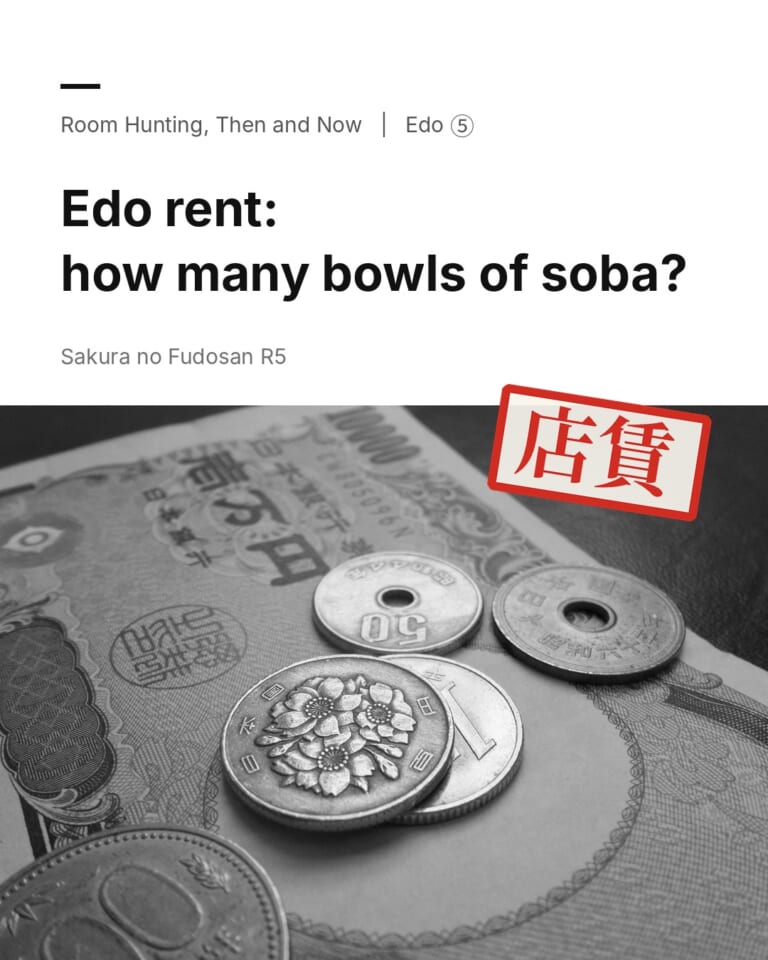
Last time we met the kushaku-niken: six tatami mats in area, no bath, a shared well and toilet. So how much was the rent? I looked it up.
300 mon a month
The official commentary of the Edo Culture and History Certification Test gives a figure for back-alley row houses: “100 mon per tsubo per month.” A kushaku-niken is three tsubo, so 300 mon a month, or 3,600 mon a year.
Rent in those days was called tanachin.
In soba, about 19 bowls
Three hundred mon means nothing to us, so let us convert it with a yardstick of the time.
Toward the end of the Edo period, a bowl of nihachi soba noodles is said to have cost 16 mon. The dates may not line up exactly, but borrowing it as a yardstick, 300 mon is about 19 bowls of soba.
If we suppose a bowl of stand-up soba costs 500 yen today, 19 bowls come to 9,500 yen. That is rent of under 10,000 yen a month.
There is another yardstick. Shinpan Edo no Kakeibo, supervised by the historian Isoda Michifumi, estimates the rent of a kushaku-niken at around 4,875 yen a month in today’s terms.
The number moves with the conversion method. But whichever yardstick you use, it stays “very cheap.”
In a carpenter’s household budget, about 8% of income
How about compared with income? A household budget for a carpenter’s family survives in Bunsei Nenkan Manroku, written in the Bunsei era (1818–1830).
The daily wage was 5.4 monme of silver. Working 294 days a year, annual income was 1,587.6 monme. Of that, rent was 120 monme a year. That works out to about 8% of income.
This carpenter’s home was “two rooms of four and a half mats,” larger than a kushaku-niken, and still that was the share.
In Japan today people often say rent should be no more than 30% of take-home pay. By comparison, rent in Edo was a light burden.
There is a reason it was cheap
If you are feeling envious, remember last time. About 10 square meters, no bath, shared toilet and well.
Cheap rent is cheap for a reason. That was true in Edo and it is true now. When you compare homes, look not only at the rent figure but at what that amount includes. Not that we needed Edo people to tell us.
A note on sources: I confirmed these figures through an article presenting the certification test’s official commentary, an article presenting the book’s content, and explanations that cite a dictionary of historical prices. Rents varied by period and place, so please read them as rough guides.
Next time: the landlord. In Edo, the “landlord” did not actually own the building.
Looking for a home in Sapporo?
Message us on LINE: https://line.me/ti/p/u2qP4VZ5ZU
Please note: Lease contracts and the legally required explanation of important matters (jūyō jikō setsumei) are provided in Japanese.
コメントを残す