This is the English edition of our Japanese series 「お部屋探し今むかし」 (Room Hunting, Then and Now). 日本語版はこちら / All English articles
At the end of the last article I asked how many tatami mats’ worth of space a nagaya room had. Here is the answer first: six. But it was not a six-mat room.
The password is “kushaku-niken”
The smallest unit in the back-alley row houses where ordinary Edo townspeople lived was called kushaku-niken, literally “nine shaku by two ken.” The dictionary gives it as about 2.7 meters wide and about 3.6 meters deep, “the smallest dwelling size of the Edo period” (Seisenban Nihon Kokugo Daijiten).
Multiply that out and you get about 10 square meters. In tatami mats, that is six.
The phrase already appears in a book of comic stories from 1773, as “a kushaku-niken back-alley home.” It was everyday shorthand for a tiny house even then.
Six mats in area, but only about four of floor
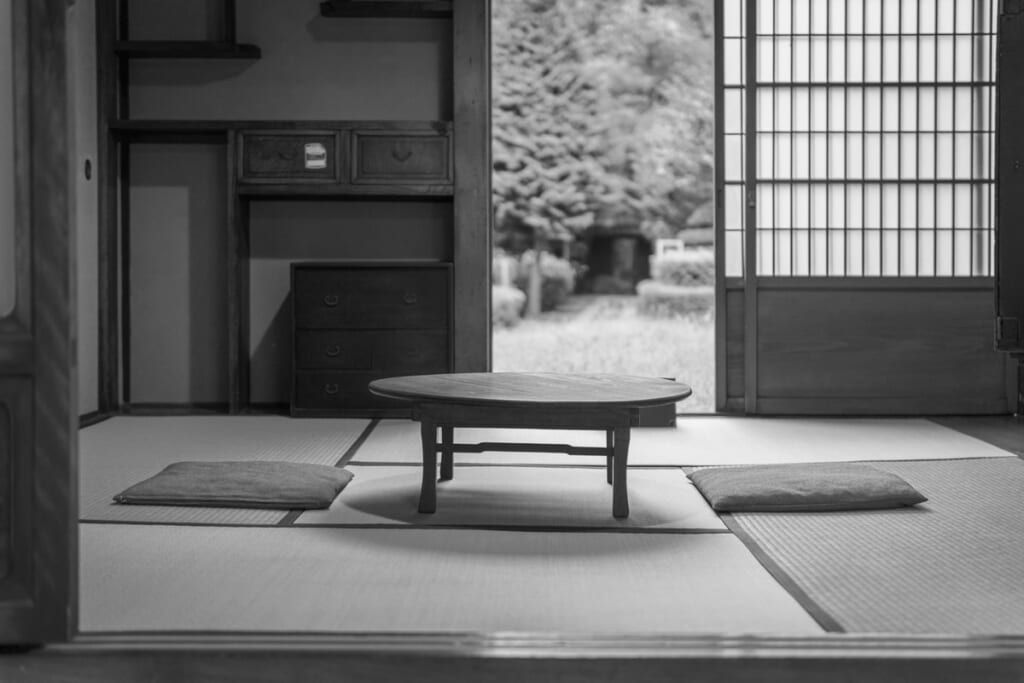
Open the door and you step first into an earthen-floor area. This was the kitchen, with a water jar, a sink and a cooking stove. The living room, which doubled as the bedroom, was the four-odd mats of tatami behind it (Shinpan Edo no Kakeibo, supervised by Isoda Michifumi).
In today’s Japanese listing terms it is a “1K.” Except the kitchen comes before you take your shoes off. Lay out the bedding and there is hardly any floor left.
No bath. Shared well, shared toilet
Now the facilities. According to the same book, at the end of the alley there was a shared well, shared toilets and a rubbish pit. There was no bath in the room. Edo people went to the public bathhouse.
Written as a listing, it would read: “1K, about 10 m², no bath, shared toilet, shared well.” If I put that ad out today, I do not think the phone would ring.
About 40% of today’s guideline
Japan’s government sets a “minimum housing area standard,” a guideline for the space needed for a healthy and decent life. For a person living alone it is 25 square meters. A kushaku-niken is only about 40% of that.
Look at it another way, though, and the picture shifts a little. The bath was at the bathhouse. The water was at the well. People shared what lay outside the room.
I once wrote on this blog (in Japanese) about treating the whole neighborhood as your living room, and not judging a home by floor area alone. It turns out Edo people were doing exactly that long ago. They beat me to it.
A note on sources: I confirmed the size in dictionaries, and the layout and facilities through an article presenting the book’s content. Row houses had larger units too; the kushaku-niken was the smallest type.
Next time: the rent. How much do you think this room cost per month?
Looking for a home in Sapporo?
Message us on LINE: https://line.me/ti/p/u2qP4VZ5ZU
Please note: Lease contracts and the legally required explanation of important matters (jūyō jikō setsumei) are provided in Japanese.
コメントを残す