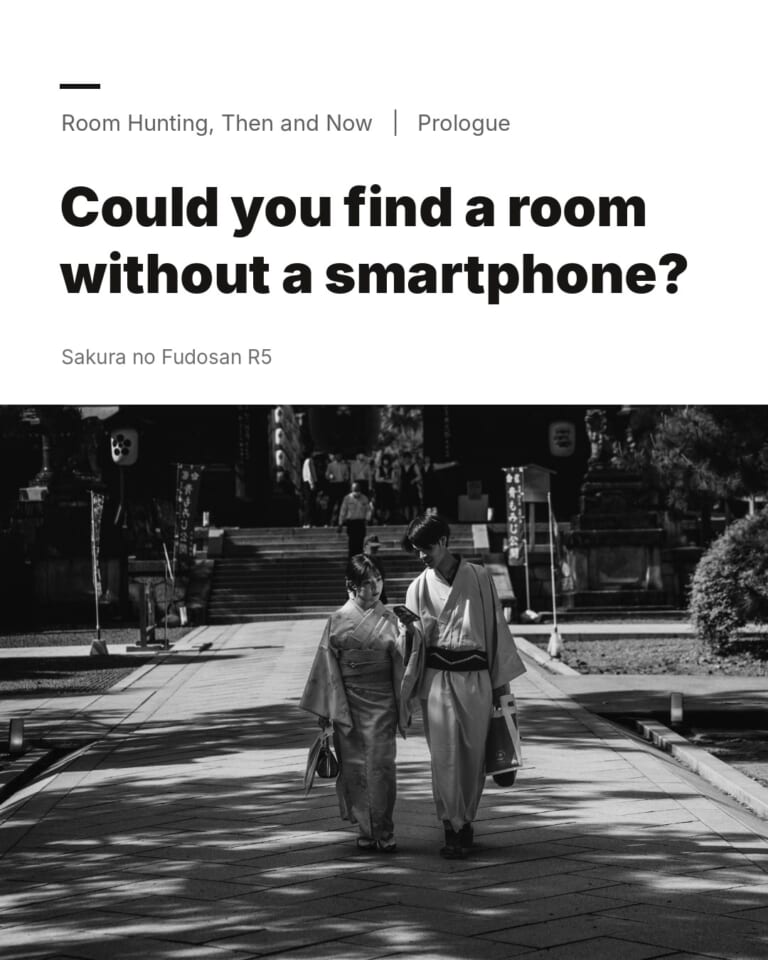
This is the English edition of our Japanese series 「お部屋探し今むかし」 (Room Hunting, Then and Now). 日本語版はこちら / All English articles
How do you look for a place to live?
In Japan, a quarter of a century ago, printed listing magazines were the standard way. Today they are a rare sight. In 2026 it is websites, Instagram, TikTok…
Lying on the couch. On the commute. Over coffee. Even while waiting at a crosswalk (on foot, of course). We can search anytime, anywhere. In exchange, searching without a smartphone has become close to impossible.
So what did people do in the days before smartphones, before even the magazines?
They walked. And walked. It was less a room hunt than a treasure hunt.
I had just finished writing a series of tips on room hunting today when I started to wonder since when all this convenience has been acting as if it had always been here. Over the next month or so, I will slowly trace how room hunting in Japan has changed, from the Edo period (1603–1868) to today.
Meet the “kashiya-fuda”
A kashiya-fuda is a slip of paper pasted on an empty house to say “This one is for rent.” A Japanese dictionary notes that it was “often pasted at an angle,” and it appears in a puppet play from the Edo period. As for why at an angle, I have no idea yet. I am adding it to my homework.
No photos. No floor plans. The clues seem to have been mainly this slip and word of mouth. In today’s terms, it is like walking into a restaurant with no reviews and no photos, judging only by the sign outside. People did that with houses. That takes nerve.
From a paper slip to a smartphone: 300 years, long and short
Here are the milestones from Edo to today.
- 1718: A “kashiya” slip appears in a puppet play (jōruri)
- 1921: The House Lease Act (Shakuya-hō) is enacted. The rules between landlords and tenants become law
- 1924: After the Great Kantō Earthquake, the Dōjunkai foundation is set up to build reinforced-concrete apartments
- 1952: The Real Estate Brokerage Act is enacted. The rules that real estate agencies must follow are set
- 1955: The Japan Housing Corporation is established. The age of danchi housing complexes begins
- 1976: Housing listing magazines are born in the Tokyo area
- 1997: Websites for searching listings appear
- 2022: Contract documents can be delivered electronically, to a phone or a computer
Listing websites only arrived in the late 1990s. More recent than you might think.
Buildings are not the only thing that changed with the times. The way information reaches us changed just as much.
Still, having more information and being able to choose a good home are two different things. Back then there was too little; now there is so much we nearly drown in it. In any era, picking a winner seems to be hard work.
I can drive, but I can’t tell you the history of the car
A confession. The lease contracts and the “explanation of important matters” documents I see every day at work: I know how to use them. I did not know where they came from. I can drive, but I can’t tell you the history of the car. That is where I stand.
(In Japan, before you sign a lease, a licensed real estate specialist must explain the key terms of the property and the contract to you. That is the “explanation of important matters.”)
So this series is not a lecture. It is a record of me looking things up, being surprised, and now and then feeling a little ashamed. Stories particular to Sapporo and Hokkaido will go in whenever I find them.
A ban on “that’s how it has always been”
Ask people in the industry why tenants hand over a security deposit, or why we sit through that long explanation before signing, and quite often the answer is “that’s how it has always been.” I have given that answer myself. In this series, that answer is banned.
Every one of today’s “normals” was born for a reason. If you know the reason, you won’t just go with the flow when you compare conditions. Being able to choose a home without visiting it in person is not sudden magic either. It is the result of 300 years of small steps.
Next time: Edo. We put the phone down and start by walking. How many houses would you look at before deciding?
Next: Why Is the “For Rent” Sign Crooked? (Edo ①)
Looking for a home in Sapporo?
Message us on LINE: https://line.me/ti/p/u2qP4VZ5ZU
Please note: Lease contracts and the legally required explanation of important matters (jūyō jikō setsumei) are provided in Japanese.
コメントを残す