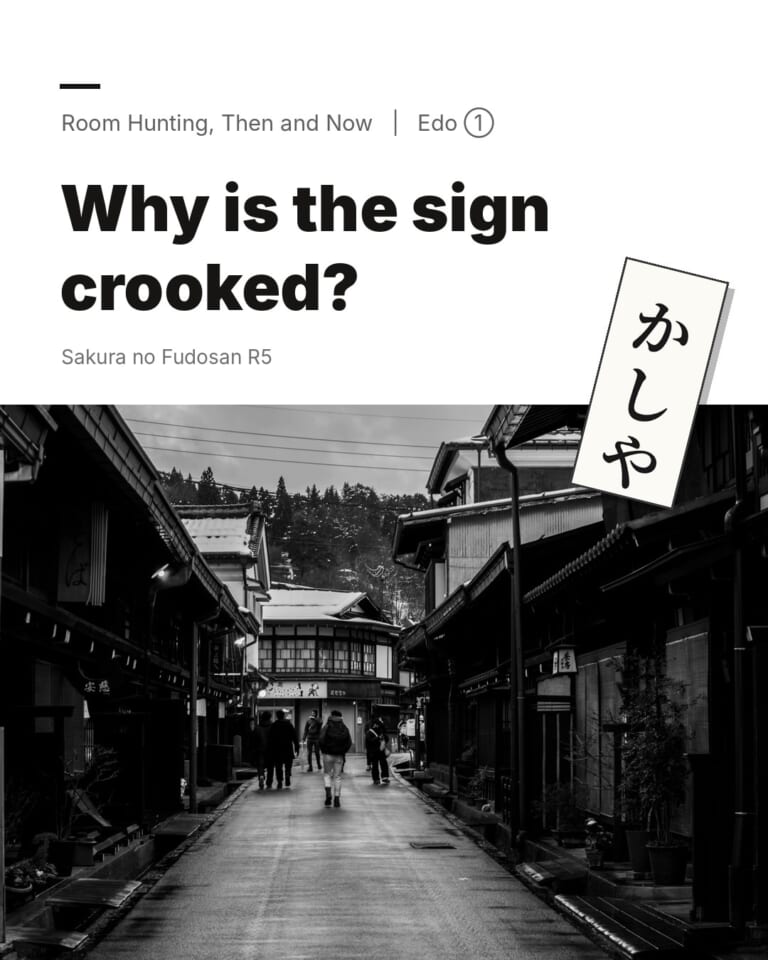
This is the English edition of our Japanese series 「お部屋探し今むかし」 (Room Hunting, Then and Now). 日本語版はこちら / All English articles
Last time I took home one piece of homework. In old Japan, an empty house for rent was marked with a paper slip called a kashiya-fuda, and that slip was usually pasted on at an angle. My homework was to find out why.
The conclusion first. I could not find out.
Homework not handed in, on day one
Let me make my excuses. I checked two dictionaries. Both say the slip was “often pasted at an angle.” Neither says why. I went through other sources too and found no solid reason.
At school I would be sent to stand in the hallway. Still, I think that beats pretending to know. I will keep looking.
A “Vacancy” sign from 300 years ago
There are things I did find.
The kashiya-fuda existed at least 300 years ago. In Hakata Kojorō Namimakura, a puppet play (jōruri) by Chikamatsu Monzaemon from 1718, there is a scene where a “paper kashiya slip” is pasted on a house that has become empty.
This was a time with no photos and no floor plans. The slip was the signal for “this one is empty.” It did the same job as a “Vacancy” sign today.
Probably, it wanted attention
From here on, this is my guess.
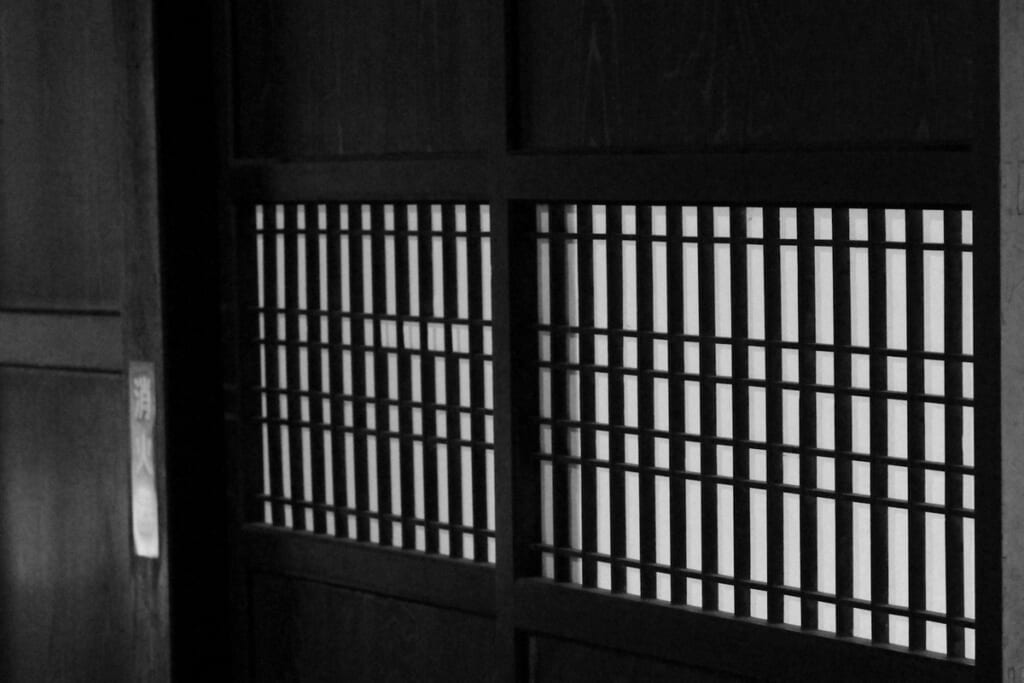
A sheet of paper pasted straight blends into the scenery. Pasted at an angle, it catches the eye. It is the same logic as a discount sticker at the supermarket: the slightly crooked one is the one you notice.
Maybe people 300 years ago were also wondering how to get noticed. Today’s listings tagged “New” or “Recommended” come from the same idea.
To repeat, this is a guess. If you know the real reason, please tell me.
You found the sign. You still can’t move in
Finding the slip did not mean you could move in right away. To rent a home in Edo (today’s Tokyo), you needed someone to vouch for you. That person was called a tanaukenin, and it was often a relative or someone from your hometown.
Today that job is done by companies. Many leases in Japan ask the tenant to use a rent guarantee company, which pays the landlord if the rent goes unpaid. In Edo, a person took that role. If you had no one to ask, all you could do was stand in front of the slip. Edo was a tough town too.
The tools changed. The steps did not
Walking around looking for slips became a smartphone search. The tanaukenin became the guarantee company. The tools have been completely replaced.
But the steps, finding a vacancy and confirming trust, are almost the same as 300 years ago. Seen that way, I can be a little kinder to today’s screening and paperwork. Just a little.

Next time, I dig a little deeper into this guarantor. What do you think people did when they had no one to ask?
Looking for a home in Sapporo?
Message us on LINE: https://line.me/ti/p/u2qP4VZ5ZU
Please note: Lease contracts and the legally required explanation of important matters (jūyō jikō setsumei) are provided in Japanese.
コメントを残す